Last Update: 04-12-2010 20:16:11
KEVIN FINNERAN
04-10-2010 23:28:16
When I realized that at some point today we were talking more or less simultaneously about eugenics, Carmen Miranda's head gear, and the triple jump, I had to ask what type of incompetent is moderating this intellectual mayhem. Apparently a fortunate incompetent because--thanks to the erudition and imagination of the participants--beneath the superficial incoherence is a rich and fascinating discussion, a jazz improvisation that no moderator/conductor could possibly have conceived.
So I will continue with minimalist moderation. We are moving into our third major section, and we are now ready to talk about what is happening now and what we expect to see next. I expect to hear from a significant number of panelists who have been observing the historical discussion from the sidelines and are now ready to get in the game. There is no end to the number of directions this could take, but to provide some shape to the discussion at the beginning, let's start with what is happening with collaborations between scientists and artists.
DAVID EDWARDS
04-11-2010 06:10:46
Sorry I am just now joining the conversation. I returned this morning - to the subject of the discussion - from Bahrain. Near the end of 2012 a new cultural center opens in Saudi Arabia, near Bahrain, called Ithra. Supported by Aramco and the Saudi King, it will hold the country's first cinema, first public theater, museums, and a catalyst for innovation called Keystone. It is, to add to the singularity, led by a Saudi team that is mostly female, a stunning site - a first YouTube video is available, some images of the design - and an ambition grounded in propagating ideas of tolerance and cultural exchange. All this to say that it is going to be a new opportunity for artist and scientist collaboration with cultural ramifications that are hard to guess at. I met yesterday with a team of young Saudis, the ones behind the making of the YouTube videos that will be increasingly appearing. The conversation was not so much around art and science as around ideas, around the future, around connecting their country freshly to new places It seems artists and scientists can go - creatively speaking - together where neither can easily go alone, find unique and common ground creating questions that require unconventional thinking, and this makes artist and scientist collaboration as relevant to addressing issues of a bioengineered future as issues of a new Middle East. All this is clearly an experiment - the evening conversations over the last week in Bahrain were characteristically dreamy - but so is what is happening in at newly emerged art and design centers, where creation is happening at frontiers of science, a cultural phenomenon that is gaining force. An experiment obviously engaged with the broader experiment of contemporary times.
ELLEN LEVY
04-11-2010 08:15:05
David’s comments about new opportunities for artist and scientist collaborations in Saudi Arabia being ‘as relevant to addressing issues of a bioengineered future as issues of a new Middle East’ are of great interest. Some of unintended consequences of our technological/cultural evolution are unfortunately entrenched. For example, it is hard to share Freeman Dyson’s optimistic belief that within the relatively brief period of 20-50 years we will have solved a major environmental problem by genetically engineering carbon-eating trees. As another example, corporate ownership of the BRAC gene (now being legally contested) makes medical testing only possible for the wealthy. It stems from the Chakrabarty patent (genetically-engineered oil-eating bacteria), which has enabled the ownership of life forms since 1980. On the positive side, to counter these developments and inequities, we are seeing a renewed emphasis in education and in art practice on remediation, eco-activism, and responsive innovation with the aims of heightening environmental awareness and fostering change. And many of these practices support art and science collaborations (e.g., Artists in Labs program) or the involvement of non-scientists (e.g., Citizen Science) as being central to success.
JAY HOSLER
04-11-2010 09:04:18
I was very happy to hear Kac recognize cartoons and cartooning as an important visual art. Obviously, cartoonist have been incorporating ideas about evolution for social commentary since the publication of Darwin’s Origin and have had a significant effect of public understanding and perception (see J Browne - Proceedings of the American Philosophical Society, 2001). Done correctly, they are terrific agents for what Matt Ridley has called “wonderstanding.”
Comics are terrific ways to engage and excite readers about science and evolution (we’ve actually demonstrated this experimentally in our lab). Larry Gonick lead the way with his Cartoon Guide series and Gary Larson frequently inserted evolutionary ideas in his Far Side cartoons. There are lots of interesting collaborations between scientists and cartoonists. Jim Ottaviani, a science librarian with a Masters in physics, has collaborated with several cartoonists (including myself) to tell graphic stories of about scientists (see his Bone Sharps, Cow-Boys and Thunder Lizards for a story about dinosaur artists Charles Knight). Biopsychologist Paul Aleixo has collaborated with artist Murray Baillon to make a cartoon biopsych text book. Felice Frankel has developed an NSF-funded program called Picturing to Learn, part of which involves scientists and college students collaborating on comics designed to explain science to high school students.
I have worked in three different capacities: 1) as the writer/cartoonist I have made five science graphic novels including a comic book text book on the evolution of the eye and a story about Darwin, 2) as an artists collaborating with a scientist, most recently illustrating May Berenbaum’s excellent Earwig’s Tail and 3) as the biologist writer working with cartoonists and a book about Evolution for Hill and Wang. Each has its challenges and those may be interesting to discuss in future posts along with why evolution can be tough to capture visually.
MAY BERENBAUM
04-11-2010 09:39:55
It's interesting that cartoons have come up in discussions of evolution. Evolution seems to hold a special fascination for animators. this may result from the fact that change is essential both to evolution and animation. Evolution results from small changes over time and, similarly, animators create sequential images, each of which is slightly different from the previous one. Also appealing is the fact that animators are limited only by their own imaginations and, more so than other types of filmmakers, can take on the challenge of visualizing almost anything, from moving breathing extinct life forms to geological processes that take millions of years. Perhaps the best example is Bruno Bozzetto's Allegro Non Troppo, a spoof of Disney's Fantasia that depicts the fate of a Coca Cola bottle discarded by a careless astronaut as it evolves...
With respect to "Fantasia," which depicts the evolution of life, the Disney studio touted that scientistswere consulted on the making of the film and in fact the printed program for the film stated “In picturing a primitive world Disney has let science write the scenario. Such world famous authorities as Roy Chapman Andrews [an explorer and naturalist who was director of the AMNH in New York 1935-42], Julian Huxley, Barnum Brown [an eminent paleontologist who discovered the first complete Tyrannosaurus rex skeleton in 1902], and Edwin P. Hubbell [the astronomer who advanced the theory of an expanding universe] volunteered helpful data and became enthusiastic followers of the picture’s progress.” This claim of scientific input, however, was disputed later by some of the filmmakers, claiming instead that the principal input for the film was content from illustrated booklets illustrated by Charles Robert Knight for the Union Oil Company...
JAY HOSLER
04-11-2010 10:03:25
That is a very interesting insight about the gradualism or evolution and animation. It reminded me of how profoundly I was influenced by a segment from Carl Sagan's Cosmos in which we see the steady morphing of animal forms as we move through evolutionary time. I can even recall Sagan pointing out lines that didn't lead to us. I was dumbstruck and thrilled as an 9th grader in biology to see the elegant transitions between the line drawings of similar body plans.
Ah! I found the clip on YouTube for those interested:
http://www.youtube.com/watch?v=bV3Xa3jPxsg
MAY BERENBAUM
04-11-2010 10:28:44
Morphing is a powerful visualization of evolution and animators have used it to great effect. Faith Hubley's 1977 animated short "Enter Life" compresses four billion years of evolution into six minutes. This film was actually the result of artist/scientist collaboration; it was produced in partnership with the US National Museum of Natural History and Kenneth Towe from the Smithsonian was an advisor...
Following Jay's lead, I, too, went looking on YouTube and found the film:
http://www.youtube.com/watch?v=4HXOgqmRcyQ
MICHAEL SAPPOL
04-11-2010 12:45:44
My sense, in the present moment is, notwithstanding the contrarian resurgence of creationism, that evolutionary discourse, evolutionary assumptions, are the air we breathe. Or to use another metaphor, the vocabulary and grammar within which we experience the material and social world. Competition, radiation succession, ecological niches, random variation, selection, catastrophism, extinction, and especially proliferation.
We are now in proliferative moment. Evolutionary discourse explains, provides a logic for, an understanding of the proliferation of life forms, and also a structure of feeling that converges with the proliferation of objects in "late capitalism", "postmodernity", whatever you want to call it. Even as the accelerating proliferation of persons, objects, ideas, technologies, categories, disciplines, transactions surpasses human understanding and control. And in this moment the linearity -- and progressivity -- of the old-fashioned evolutionary sequence looks quaint, inadequate, laughable. Which is precisely the charm of this little video animation, which shows the evolution of Homer Simpson:
http://www.youtube.com/watch?v=faRlFsYmkeY
DAVID YAGER
04-11-2010 13:37:05
Can I move this discussion in different directions? I think we are talking about some of the tools and techniques artist and scientist share, but what interests me is the content of the work and how that work is developed. Artists have engaged in many strategies that focus on the use of scientific information, imagery, equipment, and stories to contribute to their content. Certainly this applies not only to Eduardo’s work, but many contemporary artists who have used other strategies in applying and/or responding to scientific information.
Artists have responded to current and important data such as air pollution, energy, water pollution, as well as past scientific information—any of which might be proven incorrect over time. Artists can create work that uses scientific information that may point to a new moral compass, a different direction of thinking, engage a different audience in the debate, or discuss how information may be accessed in many new ways.
It is always interesting to take a look back at those things we thought were the empirical scientific thoughts of the day and how we view them, now. Did artists participate in any visual dialogue relative to the research, i.e., to frame or interpret the development of decisions for the public, or in any way influence the conclusions the public reached?
JAY HOSLER:
04-11-2010 13:44:45
JD suggested I post some artwork and my massive ego is more than happy to oblige. I thought I would do so in the context of what I see as challenges in visualizing the process of evolution in comics.
First, representing the process of evolution presents the narrative challenge of a story that takes place over millions or billions of years. Second, this million-year epic occurs at the population level. Since individuals don’t evolve this can make it tough to focus on a single central character. Third, if you do have a protagonist, you run the risk of creating a false sense of evolutionary good guys and bad guys as well as falling into the physiognomist’s pitfall of exaggerating their anatomy to underscore their narrative status. Finally, there is the problem of presenting the process as a teleological March of Progress. I have wrestled with these ideas in a number of ways
In the Sandwalk Adventures, Charles Darwin and has a conversation with two follicle mites living in his left eyebrow. I used the image below to address the idea of evolutionary teleology (I hope its below). In it we see Darwin getting up after tripping and re-enacting the classic March of Progress while at the same time his dialogue is explaining why this is not the way evolution works.
In Optical Allusions, I have the central character (Wrinkles the Wonder Brain) experience the evolution of eyes in real time. I used what James Kakalios in his book The Physics of Super-Heroes called the “miracle exception.” In this case, the miracle is that Wrinkles was traveling through a magical brew of human imagination where he did not age. In this story, Darwin demonstrates how an eye could evolve rapidly under predatory pressure. I made use of the computer modeling of eye evolution done by Nilsson and Pelger. You can download a pdf of the story here:
www.jayhosler.com/nasoasample.pdf
DANIEL GLASER
04-11-2010 14:20:12
I was really pleased to see Michael referring to the Homer Simpson evolution video since it and the famous Guinness ad were both inspirations for the Tree of Life David Attenborough animation we commissioned last year http://www.wellcometreeoflife.org/
Our intention was to generate an enduring visual expression of an aspect of evolution but to release the code and the graphic under an open source license to enable mashups.
ROGER MALINA
04-11-2010 15:43:41
OK, first let me give a plug for a new art science residency program we have set up here
in Marseille at IMERA, Mediterranean Institute for Advanced Studies:
http://www.imera.fr/index.php/en.html
As an example artist Rachel Mayeri is arriving this week and will be working with the Primatology Lab here and also neurobiologists
http://www.imera.fr/index.php/en/component/content/article/109.html
IMERA provides research residencies for artists who want to work with local scientists , or for physical scientists who want to work with social scientists etc
let me give a second plug more relevant to our discussion here:
Leonardo Books just published the book by George Gessert that looks at many of the current art-science work in biology:
http://www.leonardo.info/isast/leobooks/books/gessert.html
Green Light: Toward an Art of Evolution
by George Gessert
Humans have bred plants and animals with an eye to aesthetics for centuries: flowers are selected for colorful blossoms or luxuriant foliage; racehorses are bred for the elegance of their frames. Hybridized plants were first exhibited as fine art in 1936, when the Museum of Modern Art in New York showed Edward Steichen's hybrid delphiniums. Since then, bio art has become a genre; artists work with a variety of living things, including plants, animals, bacteria, slime molds, and fungi. Many commentators have addressed the social and political concerns raised by making art out of living material. In Green Light, however, George Gessert examines the role that aesthetic perception has played in bio art and other interventions in evolution.
at the forthcoming conference on Arts, Humanities and Complex Networks
http://artshumanities.netsci2010.net/
two artists, jane Prophet and also Anna Dumitriu working with contemporary biology will present:
Jane Prophet:
CELL was an interdisciplinary collaboration exploring the ways that research into adult stem cells re-addresses the complexity of human biology. As part of the collaboration, medical scientist Dr Neil Theise, a researcher in adult stem cells, based in New York, worked with artist Jane Prophet, mathematician Mark d’Inverno, computer scientist Rob Saunders and curator Peter Ride. One aim was visualise newand contentious theories of stem cell behaviour, and to feed these visualisations back into scientific research. Another was to generate a range of artistic outcomes that are under-pinned by the emerging understanding of cellular activity.
and
Cybernetic Bacteria 2.0
Authors:
Anna Dumitriu – University of Brighton< annadumitriu@hotmail.com>
Dr Blay Whitby – University of Sussex
blayw@sussex.ac.uk
“Life did not take over the globe by combat but by networking” (Margulis, 1997)
The transdisciplinary art project Cybernetic Bacteria 2.0 brings together an artist, a
philosopher, a microbiologist, an artificial life programmer and an interactive media
specialist, to investigate the relationship of the emerging science of bacterial
communication to our own digital communications networks, looking in particular at
‘packet data’ and bacterial quorum sensing.
Incidentally, network theory is introducing new ideas into the theory of evolution, for instance:
http://complex.upf.es/~ricard/INFONETS.pdf
Information Theory of Complex Networks:
on evolution and architectural constraints
Ricard V. Sol´e1, 2 and Sergi Valverde1
1ICREA-Complex Systems Lab, Universitat Pompeu Fabra (GRIB), Dr Aiguader 80, 08003 Barcelona,
Spain
2Santa Fe Institute, 1399 Hyde Park Road, Santa Fe NM 87501, USA
Complex networks are characterized by highly heterogeneous distributions of links, often pervading the presence of key properties such as robustness under node removal. Several correlation measures have been defined in order to characterize the structure of these nets. Here we show that mutual information, noise and joint entropies can be properly defined on a static graph. These measures are computed for a number of real networks and analytically estimated for some simple standard models. It is shown that real networks are clustered in a well-defined domain of the entropynoise space. By using simulated annealing optimization, it is shown that optimally heterogeneous nets actually cluster around the same narrow domain, suggesting that strong constraints actually operate on the possible universe of complex networks. The evolutionary implications are discussed.
They conclude:
Such a constrained set of possibilities fits very well the view of evolution as strongly dominated by intrinsic constraints (Jacob, 1976; Alberch, 1989; Kauffman, 1993; Goodwin, 1994; see also Gould, 2003 for a critical discussion). Under this view, the outcome of evolutionary searches would be not any possible architecture from the set of possible patterns but a choice from a narrow subset of attainable structures. In this context, in spite of the contingencies intrinsic to evolutionary dynamics and history, the same basic repertoire of architectural motifs would be observable if the tape of evolution were rewound and played again (and this includes the evolution of technology).
Although monsters are in principle possible (figure 10) they are unlikely to occur (the software graph shown in figure 8b would be an example). The surprising convergence of complex networks towards heterogeneous, scale-free graphs.
they show a figure of possible monsters:
FIG. 10 The logic of monsters. Mythological creatures, gargoles and other imaginary creatures define a
parallel universe of structures that are often mixtures of real creatures. Although possible in principle,
they are not observed in nature:
http://complex.upf.es/~ricard/INFONETS.pdf
a number of artists have been exploring such ideas in the field of artifical life
JD TALASEK
04-11-2010 16:42:14
I am glad to see Daniel's post about the Wellcome Trust's commissioning the Tree of Life animation. I hope that Daniel will talk more about their programs here in this context of collaboration as they really started the ball rolling on forming and supporting this type of work. The term Sci-Art is credited to them although the simple division is something I know that Ken Arnold has tried to move away from.
Daniel, what are other programs and events that have been developed specifically during this past year of Darwin celebrations? More specifically I’m curious as to what these collaborations look like and feel like? What are the challenges? Benefits?
PAUL VANOUSE
04-12-2010 01:54:29
Thanks JD for nudging me to contribute more and introduce my work. I’d like to begin by making a point that may be counter intuitive for some, but I think will shed some light on a lot of contemporary techno and biological art and also… prod discussion.
A few times in the discussion, the notion came up that artists working with science would naturally gravitate toward creating rich metaphors of evolution or related ideas to expand the scope of that imagined by scientists. This has certainly been one of the things that artists have historically done. However, I find my own practice doing just the opposite. My work has primarily functioned to expose metaphors that create false narratives—often created for commercial or ideological purposes.
To go back to an earlier example I’d posted, the term “DNA Fingerprinting” is a metaphor. It makes laypersons think of “Fingerprinting”, the proven practice of inking fingers and making identifications, that is fairly well trusted in the courtroom based on the understanding that our fingerprints are unique. When the inventor of that technology, Alec Jeffreys, points out that had he named it something different no one would have cared this is deeply problematic. The metaphor nicely covers the fact that DNA images are constructed in laboratories, using a myriad of techniques (primers, probes, enzymes, etc) and that unlike an actual fingerprint is in no way a direct impression of the body.
This is just one example of course. I became interested in such metaphors when making an educational show about the living cell in the early nineties. As an artist living in a post-modern era I was horrified by all the ways that the cell’s organelles had been described. For instance, how might the analogy of a cell to a factory be problematic in a factory town like Pittsburgh, in a Carnegie theater? Well, it would “naturalize” the notion of wage-labor, modern capitalism, etc. I want to be clear that my work isn’t anti-science any more than someone who a Century ago policed the slippery use of Evolution analogies by the Eugenicists, Social Darwinians, etc.
Anyway, this is just to prod discussion toward maybe a different type of critical artistic practice (I don’t think mine is unique by the way). I’ll include a DNA image that I created to show just how “un-natural” DNA images are—how many different ways that they can be constructed…so many that I could practically make anyone’s DNA image look like whatever I wanted it to using standard laboratory enzymes.
I should also leave a link to an online project I just did for NYFA, where I look at lots of iconic bio images and explore the narratives they create. Curious what you all think;-)
http://www.nyfa.org/nyfa_current_detail.asp?id=17&fid=1&curid=839
"Latent Figure Protocol", 2007, DNA image with actual recipe (open source) for creating your own.
"Relative Velocity Inscription Device", 2002. Ok, this is a very strange analogy that I've set up... racing my family's skin color genes to compare genetic fitness??
SUZANNE ANKER
04-12-2010 05:12:35
Dear Paul,
Can you say more about about constructing a DNA image? How can this be done?
What relationship does its visual arrangement have with its underlying scientific data?
Can this construction be repeated repeated ad infinitum or is it a unique artifact?
PAUL VANOUSE
04-12-2010 10:51:12
Hi Susanne--thanks for your question,
Yes, I must figure out a concise way of explaining this. What I mean when I say that “the DNA Fingerprint is constructed” is that A. Jeffreys publishes an article in Nature in 1985 where he notes that DNA images can be used to identify specific individuals. He includes a sample image (that he calls a DNA Fingerpring) that uses three different variations on a basic DNA imaging protocol that highlight differences between three individuals.
The procedure begins by first obtaining a sample of cells and extracting the DNA. The long strands of DNA are then subjected to an enzyme that cuts each strand at specific locations--a distinct base-pair sequence (for instance CTTAAG). These DNA fragments are then separated by size using a process called “gel electrophoresis”—each sample is loaded into the top of its own lane in a porous gelatin and is subjected to an electrical field, which pulls the DNA toward the positive pole—small fragments move the fastest and larger fragments more slowly. The DNA is then transferred to a special paper called a membrane and fixed into place.
This membrane is then washed with a radioactive “probe”. Probes are essentially DNA or RNA fragments that are complementary (meaning they form bonds) to highly variable regions in human DNA. The bound probe sticks to areas on the long DNA smear produced by electrophoresis. After rinsing off unbound probe, the membrane when exposed to x-ray film produces the iconic images with horizontal bands resembling a barcode. Since not all individuals will have the same sequence at the same points in their DNA strand, the probe will produce a different banding pattern. And provided the experiment is performed with the same enzymes/probes/gel combinations the pattern for an individual should never change. While all human DNA is 99.9% the same, Jeffrey’s method targeted the locations that are the most subject to variation, “VNTR”s—variable nucleotide tandem repeats. These locations are predictable (the same in every strand of DNA in each individual), but often vary between individuals. While Jeffreys developed the protocol during his research on genetics, he quickly recognized its implications for personal identification, patented the technique, and offered it to British police to aid in a rape and murder investigation.
Most any enzyme (of at least 100 commercially available) or molecular probe (nearly limitless) can be used in this process. Additionally, nowadays, we use a much simpler procedure in most cases that bypasses the costly, timely radioactive probe stage. There are alse variances in different countries, or when DNA is compared for different purposes, such as paternity. Different companies also use different, often proprietary complinations of things that chop, amplify, etc. your DNA to make an image.
So, when I say that a DNA image is “contructed” in a laboratory, rather than being “natural”, that’s what I’m referring to;-)
SUANNE ANKER:
04-12-2010 13:04:20
Dear Paul,
Great explanation! Thanks.
ASSIMINA KANIARI:
04-12-2010 14:03:59
And could I also refer to the workshop I am organizing at Oxford, Department of Art History on 14th May on D’Arcy Thompson and interdisciplinary thinking looking at the ‘impact’ of his ideas from the perspective of modern science (Tim Horder) as well as art (Susan Derges, Ellen Levy) and various historically and theoretically minded people which you can find in the flyer (Roger I did it!)
Disciplines, Objects and Interdisciplinary Thinking in Art History 1950-2000
Biology, D’Arcy Thompson and the Historical Explanation of 20th Century Experimental Art Form
Workshop 14th May 2010: 9.30
Department of the History of Art, LittleGate House, St Ebbes
Martin Kemp, Susan Derges, Ellen Levy, Tim Horder, Michael Weinstock, Matthew Jarron, Assimina Kaniari
Convener: Dr Assimina Kaniari, (Art History, Oxford)
This event is free. To book a place RSVP assimina.kaniari@hoa.ox.ac.uk
Celebrating the 150 years from the birth of Thompson, the workshop will explore the impact of his conception of form, and ‘acts of seeing’ first presented in his seminal 1917 book On Growth and Form, on post-war theories of vision, and the writings of Gombrich and Read, as well as their figurations in avant-garde art of the 50s (Assimina Kaniari, Oxford), (Mathew Jarron, Dundee) and their later legacies in contemporary architectural theory (Michael Weinstock, AA), visual arts (Ellen Levy), photography (Susan Derges) and science (Tim Horder, Oxford). Martin Kemp (Oxford) will offer closing remarks and will act as discussant.
To rethink interdisciplinarity in art history we will adopt Ian Hacking’s formulation of being “interdisciplinary” as “applying my discipline in different directions”. Thus in tracing the development of post war art historical discourses, and their figurations in avant-garde art, as well as their later legacies in art, architecture and photography in dialogue with Thompson’s form, we will focus on the problems, tensions and questions that post-war domains of visibility, orders of vision and aesthetic hierarchies, fixed in the every day experience of 1950s modern culture yet drawn from visual cultures distinct from art, narrowly defined, posed for historical method and its boundaries in post-war as well as current art historical practices of revision (Ian Hacking, ‘The Complacent Disciplinarian’. http://www.interdisciplines.org/interdisciplinarity/papers/7 )
SUZANNE ANKER
04-12-2010 14:57:17
This looks great. Will there be a web presence or publication?
ASSIMINA KANIARI
Dear Susanne,
Thanks! (I hope that message was for me!) I would love to publish it and would be great to have you contributing (it would certainly make the case a stronger one for a publisher!) I have also been trying to pursuade Guna!
DANIEL GLASER
04-12-2010 16:13:08
In response to JD's prod, here are three quick posts first about Wellcome's Darwin initiative, some SciArt stuff and finally a bit of personal theory about frameworks for collaboration.
Most recently we've done a big initiative around the Darwin bicentenary, under my department which is Special Projects. The thought is to take large scale cultural opportunities and engage with them to bring cutting-edge biomedical content to a wide audience in the form of a conversation which they control. We held a number of consultations with the great and the good of evolutionary biology and the arts and came up with some simple high-level concepts such as a Darwin experiment for every schoolchild in Britain, an enduring visual symbol, something in the online realm and then spent two years and a few million pounds on making them happen. We reached all 23,000 primary schools in Britain and 65% of the secondary schools with a series of hands on experiments (http://www.wellcome.ac.uk/darwin200) which are kind of what we imagined Darwin would be doing now (sexual selection in brine shrimp, breeding new antibiotic resistant bacteria (in the classroom, really)) and all lodged in a contemporary cultural vernacular, in this case TV game shows. I've already referred to the Tree of Life video and its remixable potential. Finally, in collaboration with Channel 4 in the UK we commissioned a project for teens and young adults online at http://www.routesgame.com/ which is really about genetic testing. It takes the form of some rather poppy minidocs, an alternate reality game and some trivial and in some cases disgusting video games, one of which has had over 15 million online plays.
The initiative was very successful in embedding the content in cutural forms, especially gaming, which are often excluded from the high cultural mainstream (for an excellent discussion of this, see John Lanchester's lovely LRB piece: Lanchester, J. (2009). Is it Art? London Review of Books, 31(1), 18-20. Retrieved from
http://www.lrb.co.uk/v31/n01/john-lanchester/is-it-art)
Set texts here would be online, particularly http://www.wellcome.ac.uk/sciartevaluation
Briefly for context, the Trust was founded by the pioneering drugs baron Sir Henry Wellcome who believed that medicine could only be seen as part of culture http://library.wellcome.ac.uk/node615.html and therefore collected not only remedies from around the world, but also the bottles in which they were stored, the masks which were worn by the prescribers, in some cases the canoes in which they travelled to work and the shrouds in which their patients were buried. This legacy allows us to fund around a billion dollars worth of medical research a year but also to fund collaborations between artists and scientists. Some key points to note about what we commission and fund are that we expect the science and the art to pass the highest standards of peer review in their respecitve disciplines (I'll give some personal notes on this in the final post) and that there should be a meaningful and substantive process of interaction at the heart of the piece, but that we do not necessarily expect the outcomes to be symmetrical.
Finally some deliberately provocative thoughts of a personal nature about interdisciplinarity and therefore artist/scientist collaboration. I do try to embody these in the work that I commission at Wellcome, but the musings are not official policy ;-) I'm on the record at greater length on these issues for example at a meeting of ResCen at Middlesex University, London: http://www.rescen.net/archive/mis-seeing204.html
First, I am a fan of disciplinary boundaries, and I have sort of self-similar fractal theory about how they work which says that the forces which keep groups apart are the same at many scales. This is to say that the social and cultural mechanisms which separate artists and scientists are the same as those which separate biologists and chemists, neurobiologists and immunobiologists, visual neuroscientists and motor neuroscientists, and these are things like lingo, jargon, publishing coteries and conferences/parties. I'm a fan because I think effective collaboration often involves people who come from explicitly different disciplinary traditions and who are clear about where they come from.
I have developed a 'convergent-divergent' theory of interdisciplinary collaboration which starts with these different disciplinary origins but then supports situations in which true collaboration can take place. In the heat of these collaborative interactions, moments of Dionysian frenzy can occur, where any participant can comment on any aspect of any form within the collaboration. Importantly as the collaboration shifts into a production phase there is a divergence, and, by default, the outcomes are recontextualised within classical disciplinary boundaries. Of course this process can be chained sequentially many times.
This approach deliberately problematises hybrid outcomes and disciplines. Of course the structure of scientific revolutions teaches us that new paradigms are essential to fundamental shifts in our understanding of the world, but conversely most of the valuable progress we make best understood in terms of established systems.
I offer the above in the spirit of theoretical provocation.
SUZANNE ANKER:
04-12-2010 17:59:33
Dear Assimina,
It sounds like a fabulous project. Count me in. The importance of D'Arcy Thompson to many generations of visual artists, to my mind, has never been fully articulated. It is a project, particularly ripe for consideration in light of the current explosion of 3-D modeling programs and bio-applications. A few years ago, I had the pleasure of lecturing at the Pollock-Krasner Study Center in East Hampton, New York, where I was also invited to spend night. Not surprising, but equally as thrilling, as I perused the books in his library, there it was, a copy of Thompson's "On Growth and Form."
TRACY HICKS:
04-12-2010 18:34:12
I am pulling and reintroducing this slightly edited from a thread lost yesterday:
Most scientists I know are artists. They approach their work with conceptual skills and a craft honed over centuries of scientific refinement. Essentially since Linneaus named the world and created an organized structure for collection and cataloguing science became a systematic art form.
Equivalent and more obvious arguments can be made that art incorporates science. Art materials are often bi-products of science. I regularly use materials developed for scientific purposes. I have sought and found the help of scientists specializing in liquid preservation and natural history collecting and collection. But I am a blue collar visual artist who knows that I am not a scientist. I try to keep up with the latest scientific literature on the amphibian decline, but also understanding gleaning fully from scientific literature is beyond my sphere of knowledge. So the factual honesty within the structure of science without visceral interpretation also exists outside my sphere.
Visual art, Visual Culture and Science Culture overlap. We suffer from a lack of acceptance of our mutual strengths and benefit tremendously from the collaborations that accept our individual strengths.
CHRISTINA COGDELL:
04-12-2010 20:16:11
Assimina, I took am interested in the proceedings of your D'arcy Thompson symposium. I wish I could be there, but can't. Is there any way the proceedings can be recorded and posted? I'd love to hear all of the discussion, and love the interdisciplinary crossover. Mike Weinstock's work is of definite interest for my current project on architecture, and I plan to be at the AA in the fall doing research in their archives on the history of computation and evolutionary architecture. I'd love to meet you then too, if you'll be around.
NATHANIEL COMFORT
04-12-2010 21:58:16
First, D'Arcy Thompson is one of my absolute heroes. On Growth and Form was for me one of that handful of creative works that becomes a lifelong touchstone. So glad to see him getting that kind of serious treatment.
Daniel: Very interesting and challenging remarks about disciplinary boundaries. I appreciate that you are taking a somewhat polemical stand to stimulate discussion. It is evident to me that what you are really interested in is *crossing* those boundaries. And so you like to have clear boundaries to cross. Fair enough. I've done the same in my life, getting formal training in both science and history.
My question is about the last stage, the recontextualization of the hybrid content within the paradigm of one discipline or another. Maybe I've been unlucky, but in my experience in order to take this new rough asymmetrical object and reframe it in conventional disciplinary terms requires paring off all the edges that make it interesting. Those who police the boundaries of the disciplines I mostly work in are Death Eaters.
In short, disciplines are intensely conventional, and therefore their gatekeepers tend to stifle creativity. My preferred audience is generalists and the educated lay reader. People without disciplinary commitments. They seem most comfortable with work that spans disciplines.
DANIEL GLASER
04-12-2010 22:38:54
(Nathaniel, of course you're right that I'm taking a rhetorical position here so let me continue for the sake of argument :-)
The point about gatekeepers stifling creativity is fair but consider the alternative. So much sci-art collaboration has ended up with hybrid outcomes that satisfy noone ie second rate art which misses the scientific point.
The fMRI work I've done has included collaborations with choreographers as well as anatomists but in the end was submitted to neuro journals without special pleading. It had to be top flight science and was actually more stringently peer reviewed because of the aparently 'trendy' arts involvement. That's fine by me. Equally successful dance outcomes should fill Sadlers Wells and be adored by the Guardian's dance critic. That way you know you're on song.
TODD SILER
04-12-2010 23:58:21
Collaboration: That phenomenal thing that happens between and within our brains, enabling us to do what often cannot be done alone by one’s individual will and effort. Great collaborations are astonishing because you see and feel people doing so much more than merely cooperating in sharing their thoughts, ideas, knowledge, resources, and expertise. They’re willfully and enthusiastically merging the sum of their knowledge or wisdom applied toward to a common shared goal.
Google “Great collaborations” and 3,950,000 links appear in 0.90 seconds (give or take a few repeated links); and you won't find that company at the top of the list, even though they've elevated the state-of-the-art of all search engines to the stratosphere and beyond).
What makes great collaborations successful? What makes them work, as opposed to “work”? What makes them sing, instead of scream? Or inspiring, rather than deadening? When do they soar, versus crash and burn? Human history is pockmarked with plenty of examples of both: from the 19th century collaborative effort that went into constructing the Eiffel Tower in 1889 and The Chicago World's Fair in 1893 to the formation of the Darmstadt Artists’ Colony in Mathildenhöhe in Darmstadt, Germany in 1899; the latter example is one tragic case study in what-not-to-do or what to expect from the clash of titanic egos; that Colony imploded within two years from the time it opened its doors to the public. It was a beautiful concept, but implemented without an awareness of the chemistry of personalities.
I’ve seen my share of collaborations and have participated in enough of them to know intuitively what things feel “right” with them, and what realities make them stink from the start. (You don’t have to wait for that day-old fish to arrive rolled up in a newspaper either to know for certain, like that chilling scene from Mario Puzo’s novel, The Godfather!)
Whether you’re collaborating with landscape architects and city planners to construct a park (www.civitasinc.com), or collaborating to “build a knowledge-driven organization” (Buckman, 2004), or collaborating to improve the performance of organizations worldwide (Holman et al, 2007), or collaborating to change the world (Stephen et al, 2006; www.Worldchanging.com), the arts and sciences are intimately involved in countless ways. And you can count on them, too, for reasons I’ll relate shortly.
Everyday, ArtScience collaborations are happening everywhere: from our worlds largest transportation centers to our leading hospitals and medical research centers where teams of scientists wield some of the most complex medical imagining technology applied to everything: from the ER room’s ICU to the oncology lab to the fleet of paramedics.
Some of the more recent high-profile examples of this ArtScience collaborations are visible at the Large Hadron Collider (LHC), high-energy particle accelerator build by CERN and the construction site for the world’s largest Tokomak nuclear fusion device (www.ITER.org) being built by an 11-nation consortium as we speak in Cadarache, France.
Equally impressive are those collaborative projects underway that involve polymath specialists from a spectrum of fields building ever-more versatile, relational data-mining tools. Software and webware designed to enable labs worldwide to collaboratively analyze, diagnose and treat millions of the most complex structures in the universe (human brains) using sheer ingenuity, imagination and an assortment of medical tools, such as PET, MEG and fMRI (Phelps et. Al, 1986; Doidge, 2007) that only a handful of centuries ago only visionaries like Leonardo could’ve foreseen.
In my next post, I want to provide some specific examples of these ArtScience collaborations—to point out what has changed today in the “new landscape,” to invoke the vision of Gyorgy Kepes, the pioneer environmental artist and founder of MIT’s Center for Advance Visual Studies.
What’s really changed is “Art.” It’s finally become what its DNA was born to do: Transform everything imaginable in our built and natural environment into new, personally meaningful and purposeful things.
ASSIMINA KANIARI
04-13-2010 06:05:58
Dear Susanne,
I am thrilled!!
Fantastic and many thanks!
Christina, that would be great! I will see what can be done with the workshop. Your work sound's fascinating and would love to hear about it. It would be perfect for the book too (think about it!).
ELLEN LEVY
04-13-2010 06:43:16
David Yaeger asks us to focus on the content of work and how art can engage a different audience. In this same thread, Roger points out the art/sci collaboration of Jane Prophet and Neil Theise with respect to investigating contentious theories of stem cell behavior through visualizations that then are scientifically analyzed. It is encouraging to see collaborations taking place on both the micro (organismal) and macro (environmental)levels, many of which (like Jane and Neil’s earlier collaboration) rely on complex systems approaches. Although not yet nearly enough, let me point your attention to the fact that increasingly, conferences assembled to discuss shared critical public concerns have been including artists, art/sci teams, and not scientists alone in these discussions. As an example, the upcoming Hiddensee workshop on Aesth/Ethics in Environmental Change will take place from May 24-28on the Hiddensee island in Mecklenburg-Vorpommern, Germany. It brings art and artists into the discussion, asking such questions as how can arts widen our perception of nature, how aesthetics and ethics are connected to each other in habitats, and it plans to explore the “worldviews, values, rituals, visions, belief systems and ideologies” at work within the human ecology. Significantly, an ‘Asilomar 2’conference on climate intervention technologies took place last week, focused on climate intervention and carbon remediation. This opens a nascent field and hopefully, artists will be included in the next meeting. One recalls that a criticism of the first Asilomar conference in 1975, when molecular biologists were concerned with the possible ramifications of rDNA technology and runaway bioagents, was that it largely excluded the insights of non-scientists.
My subject remains art and science collaborations, but this time, with JD’s encouragement, let me also offer some observations as an artist collaborating with neuroscientist, Michael E. Goldberg at Columbia University. His life-long work is the study of attention. Our collaborative animation and installation, Stealing Attention (2009), became, in effect, an art experiment. It deliberately engaged the viewer in a distraction that elicited a failure of awareness under conditions of selective attention. For those who are interested, see http://www.complexityart.com/Reviews/sciart.htm. The issues involved the ability of art to re- train attention and the significance of emotional and political content. We used the video, “Gorillas in our Midst,” as an initial model, but the real models are the performative works of magicians. Just as the meditative abilities of Buddhist monks have been explored by neuroscientists in recent years, the talents of magicians have also been acknowledged pertinent as evidenced by a Magic of Consciousness symposium in 2007 sponsored by the Association for the Scientific Study of Consciousness. Such symposia now provide a terrific way for magicians and neuroscientists to learn from each other (Macknik et al., 2008).
TODD SILER
04-13-2010 08:41:32
“Art” today is not only what you see shining in the spaces of art museums, exotic galleries and elegant homes. It’s also all that “dark matter” stuff we can’t see at the moment. And yet, we can sense its presence in the human universe in the same way astrophysicists and mathematical physicists sense that there’s so much more to matter than what meets our eyes and technology. I mean, we’re not building the Large Hadron Collider because we’ve already seen it all and know it all; “it” being all the particles and forces of nature that make up the phenomena of the universe.
Here’s what I think has changed today and forever about Art and everything we do with it, know about it, experience with it, and transform with it. A.r.t. now encompasses All representations of thought: from the back-of-the-envelop math notes on napkins to simulated physics events in the CMS detector of the LHC that highlights the Higgs boson; from the gestures mimes make to describe the world without words to the sounds of an orchestra makes to treat our imaginations to new worlds of music; from the silence a performance artist uses to help us hear life anew to the simplest things our robots make and are programmed to give purpose to by means of our imagination.
In A.r.t, anything goes, because imagination goes with anything. Any and all mediums can be used to create and apply A.r.t.: from the French Dadaist Marcel Duchamp’s artifacts composed of dust to the cosmic works of epic proportions, “The Quiet Axis” and “The Seed of the Infinite Absolute,” created by the visionary environmental artist Lowry Burgess; years ago, this multimedia artwork was launched into space traveling aboard the Space Shuttle as a nonscientific payload.
There are many contemporary visual artists who’ve produced a wealth of original A.r.t. that exemplify what I’m describing here, and that have stood out as collaborative endeavors. Case in point: Arakawa & Gins, The Mechanism of Meaning, 1971 and Constructing the Perceiver—ARAKAWA: Experimental Works, 1991. Viewing their ambitious, multi-part, experiential art installations gives a whole new meaning to purposeful mashups. Their work has contributed to another kind of “web development” that involves stimulating way more than the 1012 neurons in our brains. In many respects, Duchamp hinted at this larger weave of connection-making with his “mile of string” for the First Papers of Surrealism Exhibition in New York, October 14 to November 7, 1942.
My point is: The broader our definitions of A.r.t, the richer, deeper and more meaningful our experiences are. Many years ago, I did some basic thought experiments to test this premise: We tend to experience things by how we define them—and also, by how we categorize and compartmentalize our experiences. When we expand our definitions of art, we experience how art naturally encompasses the spectrum of human endeavors. If I immerse myself in a chemistry lab project while being guided to see how similar experimental painting is to the aesthetic experiences I’m having conducting an everyday chemistry experiment, I’m inclined to rethink what it means to “do science” and to “make art.” Suddenly, the whole world of symbolic languages looks and feels differently to us. And they can be purposed differently, too.
So there’s a “new & improved” role the arts are playing today, as artists collaborate with virtually every form of knowledge and human endeavor, and every medium for expressing and representing human knowledge. And this purposeful play of intellect and imagination can, indeed, contribute to the advancement of science, technology, engineering mathematics (STEM) projects. More importantly, they can contribute to our collective creation of a sustainable future.
The value judgments we make about “good” and “bad” A.r.t. only serve to demonstrate the limits of our consciousness and definitions, not the reality of the things we create and purpose as Art. The long History of Art and its interactions with all the other forms of knowledge shows this natural evolution in our experiences possibilities of our experiences and understanding
Of course, in our world of economies, in which everything is subject to global markets and success is measured by these “markets,” we always manage to give some arbitrary “value” to our A.r.t.ful creations. Never mind the fact that there are no limits to A.r.t. , as it conceptually, physically and experientially defies our full definitions and experiences of it.
TODD SILER
04-13-2010 12:40:52
No doubt, everyone participating in this exchange here has her and his lists of examples of A.r.t. some of which were born from “ArtScience” collaborations (meaning, art that fully integrates science in its acts of creative inquiry and representations (e.g., D’Arcy Thompson, Albert Einstein, Marie Curie, Barbara McClintock, Linus Pauling, Richard Feynman, etc.), while others were the products of collaborating scientists and mathematicians who followed the conventions and protocols of modern scientific enterprises.
My list of ArtScience collaborations stretches from one end of my studio to another [in its linear presentation], and it fills a giant gulch bag [in its nonlinear presentation]. Either way, there’s no chronological order to this list, or thematic order, or aesthetic order. But there is this unmistakable, unspoken “connection” between them all that I’ve traced to three fundamental facets of behavior, which they all seem to have in common. I’ll get to that point in a moment.
First, I’ll reach into the gulch bag and randomly draw a handful of these notable nontraditional collaborators who integrate [to various degrees] aspects of art-science-technology, among them: Arakawa and Madeline Gins (http://www.reversibledestiny.org/VIRTUAL1.html); Jeanne Claude and Christo (http://en.wikipedia.org/wiki/Christo_and_Jeanne-Claude); (http://www.nytimes.com/2009/11/20/arts/design/20jeanne-claude.html); Otto Piene and Elizabeth Goldring (Centerbeam/MIT CAVS, 1980), Newton & Helen Mayer Harrison (http://www.greenmuseum.org/content/artist_index/artist_id-81.html); Andrew Jones and Christian Ginzel http://www.jonesginzel.com/); Robert and Michele Root-Bernstein, co-authors of Sparks of Genius, 1999 and their blog Imagine That! for Psychology Today; Steve Jobs and his Apple makers and harvesters; Jon Hirschstick and his CAD/CAM collaborators who built SolidWorks (http://www.solidworks-apac.com/2009/02/19/solidworks-founder-jon-hirschtick-predicts-the-future-of-cad/); Shai Haran and his collaborations in pure mathematics at the Technicon-Israel Institute of Technology, Haifa, Israel (The Mysteries of the Real Prime, 2001); Pam Solo and her collaborations through Civil Society Institute (http://www.civilsocietyinstitute.org/); Dee Ward Hock and his collaborations (One from Many: VISA and the Rise of Chaordic Organization, 2005; Chaordic Commons. 2005-12-01), and Kofi Annan and his closest collaborators tasked with implementing the innovative initiatives of the United Nations.
Clearly, it’s a mixed bag of examples, I've randomly chosen. But any one of these examples may help crystallize this point: Reality is more than a “mixed-metaphor.” Rather, it’s a constant mashup of life experiences that require our full powers of artistic & scientific creative-critical thinking skills to help make sense of our experiences, and to understand how to use them constructively in collaboratively building on them in productive ways.
Essentially, that’s what’s at stake today: Improving human communication to the point where we can better understand and help one another. In this way, we avoid creating the ultimate breakdown from miscommunication, that proverbial “Tower of Babel” first envisioned by Pieter Brueghel the Elder. Such a structure naturally forms when we don’t connect and integrate the endless piles of human knowledge that have been diligently aggregated and established independently by groups of thinkers doing their thing in intellectual isolation and with hidden agendas that worked against the process of strengthening civil society.
The Tower of Babel by Pieter Brueghel the Elder, 1563
TODD SILER
04-13-2010 14:27:39
The legendary art historian Meyer Schapiro was a master at making connections. As one review of his life in The New York Times (March 4, 1996) related: “It was not in his nature to function as a specialist within any one particular discipline. Even less was he a satrap of the seminar with specific "turf" of his own to protect. It was, in fact, the very essence of Schapiro that he never conceived of any aspect of art, of belief or of language in isolation. He regarded all forms, schools and systems of knowledge as interrelated and interdependent. As far as he was concerned, he had been put on earth to know, and to make known, the correspondences between them all. And he addressed himself not to the insider, but to the generality of intelligent human beings.”
When people earnestly ask me these sorts of anxious questions—“How do we use the arts and sciences better to help improve the state of the world? How do we make a better future, when no one knows what 'better' really means or amounts to, and no can agree upon the characteristics of ‘betterment’?” -- I simply point to the work, life and thought process of Meyer Schapiro. And I say, “That’s how! Study his approach to innovation and collaboration. Study the way he collaboratively learned. Schapiro's approach is as generalizable as it is timeless and ageless.”
Or, I’ll point out other thought leaders in the interconnected fields of art-science-technology-engineering-mathermatics-business-education-politics, and say: “Do you see what those individuals are doing with that Wheel of Change & Communication? They’re learning about some basic ways of improving the communication process by collaboratively building and learning from their symbolic model. And then, they’re guided to reflect on their experiences in order to understand what they made, how they made it, and what their symbolisms mean to them. In effect, they’re trying their hands at this form of ‘constructive’ communication.”
After that silent moment of blank stares passes, I’ll proceed to explain how these people are making all kinds of compelling “connections” in generating and sharing new knowledge through this multi-dimensional symbolic model that they’ve collaboratively created. They made this model to show-and-tell each other what CHANGE & COMMUNICATION mean to them both personally and professionally—rather than assuming they all held the same mental models. On one side of that spinning, symbolic wheel, they placed all the things they’ve identified about human communication that they believe will never change. Like the constant speed of light, they felt that certain qualities of human interaction seem hard-wired (that is, until our neural wires are changed through informal experiential learning and neuroplasticity (Doidge, 2007). On the other side of this wheel, they’ve highlighted [with words, images, moveable objects] all the things they feel will change about the way we communicate both physically and electronically.
My point is: one of the keys to transforming the way we collaborate as artists and scientists is to utilize these sorts of arts-based learning tools in the process of creating and sharing new knowledge. This “Postmodernist” artifact of thought serves as a visual aid for storytelling; it uses any or all contents its creators choose to include in showing-and-telling their story. Basically, it’s rooted in a process of creating and communicating that’s as universal as it is many thousands of years old.
TRACY HICKS
04-13-2010 18:30:31
Todd's descriptions of good/bad art followed by the potential for art violence deserves reinforcing. The spectrum of art covers a full range of human potential which is (of course) another correlation to science as collaboration.
Todd Siler wrote, “My list of ArtScience collaborations stretches from one end of my studio to another [in its linear presentation],”
The line stretching across Todd's studio provoked the thought of a collaboration (of sorts) between the panelists and readers. A time machine. I have a line stretching the length of one wall in my studio that is my personal time machine.
Simply draw an 8 foot line scaled to one inch equaling 3 years. It will span 288 years
At one end mark off the current year then back 150 years (4 feet 2 inches) to Darwin and further back 100 years (33.3 inches0 to Linneaus.
My shoulder width is roughly my life span from birth to present.So for me Darwin is only two shoulder widths back and Linneus is suddenly closer than I would have realized
A shorter line would do but before Linneaus is an important time to see into.
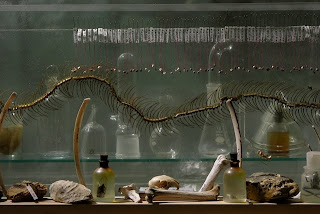
My list of science collaboration projects is much shorter than Todd's. I'll follow this post with a description of an installation collaboration between the Field Museum in Chicago, the University of Kansas Biodiversity Center and my collection of frogs cast from their collections,
A few years ago then University of Kansas faculty members Marjorie Swan and John Simmons raised a grant from the Museum Loan Network for me to cast specimens of extinct and threatened amphibians both from the old world collections at the Field Museum and their new world counterparts at the University of Kansas Biodiversity and Natural History Museum.
The obvious premise that the actual specimens each being one of kind markers and far too fragile for public viewing created a format to present the collection cast and in similar surroundings as the actual vaults where the original specimens are kept in consistently monitored cool darkness.
As you can see in the images I played with the lighting adding phosphorescent pigments and UV lighting to extend the life of the frogs into the installation.I let the visual speak from here:
TODD SILER
04-13-2010 23:19:20
Adding another maleable “brick” to Tracy’s and Marcel’s inspiring wall of ideas, and building on what Assimina has wisely noted here, too: Today, there seems to be a natural integration of artistic & scientific knowledge, methods of creative inquiry, and approaches to real world problem solving that is reshaping our ways of “world-making,” to borrow the analytic philosopher Nelson Goodman’s phrase. We probably inherited this form of integrative thinking from the Italian Renaissance masters, and much earlier. But no matter where or how we inherited it, it has proven to be one of our more useful and versatile “thinking tools” for transcending centuries of compartmentalized thinking (Root-Bernstein, 1999). This particular tool of creative seeing and thinking can help us bridge in minutes ideas, concepts, and theories that need to be explored by everyone and not just the lonestar individual or group that conceived of them.
In any event, integrative thinking enables us all to discover the nature of the world and the world of human nature. It encompasses all ways and means of expressing, representing, modeling, simulating, and demonstrating our knowledge and experiences.
The upshot is: Integrative thinking can be purposed towards anything that collaborators care to apply it: (in medicine) building customized “biobricks” for more uniquely personalized gene therapies; (in neuroscience) designing more neurophyiologically precise treatments that target only the "problemmed" cell/neurons; (in engineering) using nature-inspired materials to construct more effective and efficient structures with a myriad of practical applications; (in education) enhancing the personal meaning and all-purpose usefulness of creative learning.
Will this approach help us do a better job of weighing the risks and benefits of, say, genetic engineering, recombinant DNA technology, or genetically modified/manipulated (GM) matter through gene splicing? Will it help us make good decisions about how we transform biological matter into new living things?...things that may be far more adaptive and responsive to life, but pernicious beyond imagination? I don't have the expertise to answer that, but Sheldon Krimsky did in his insightful book, Genetic Alchemy: A Social History of the Recombinant DNA Controversy (The MIT Press, 1979). His perspective hasn't aged a bit. For me, it's still a relevant read.
Dr. Fred Alan Wolf, author Taking The Quantum Leap, sums up concisely what I’m trying to say: “What science does best is create art, and what art does best is envision new science.”
As I percolate on that piece of wisdom, I’m thinking about its “reality” today (and not its just possibility); and I’m wondering where the applications of that reality will ultimately take humankind. Reading about the exciting work of The BioBricks Foundation (BBF) http://bbf.openwetware.org/, I know that we are and will always continue to develop technologies responsibly. At least, I hope so. But I also know human nature: eventually, some biological engineer or group of synthetic biologists will try to transmute these BioBricks,™ (just because they can in the name of innovation, and just because they’re up for the challenge) -- thus manipulating “standard DNA parts that encode basic biological functions” to the point where they’re nothing like the living organism we intended or programmed them to be. Enough said. I’ll just leave that thought dangling…
Gazing into the opaque “crystal” ball of the future, I see the arts fully intregrated in the sciences where all the arbitrary boundaries and barriers have been moved aside for those individuals and groups who desire to collaborate towards the benefit of The Common Good; thank goodness, there are many organizations that are committed to promoting some humanitarian “do-good” philosophy (http://www.ideaconnection.com/solutions/) -- a life philosophy that resonates with the inspired instincts of The Good Samaritan. That simple parable is well worth re-reading in these complex times. It splashes me with hope for the human race.
TRACY HICKS:
04-14-2010 10:19:18
Todd's deeply poetic good samaritan analogy is very appropriate when he wrote, “I see the arts fully intregrated in the sciences where all the arbitrary boundaries and barriers have been moved aside for those individuals and groups who desire to collaborate towards the benefit of The Common Good; thank goodness…”
I hope we will hear more in this wrap-up phase from the other artists on the panel. Marta I know works directly with science as medium. We were denied entrance to a restaurant in Grinnell Iowa last year. Brandon Balangee is completing a PHD and while I've seen little of his recent work, his earlier work should be inspirational in this conversation.
My work is on the periphery of science combining the collections of art and science to reassess. Todd,Marta and Brandon and other artist/scientists we have and have not yet heard from work with science as medium. Art work combining offers a world of possibilities beyond Huxley's Brave New World. Which I fear is still inhibiting.
TODD SILER:
04-14-2010 15:58:04
Thank you, Tracy. If I've strayed too far in the wilderness, please call out and I'll stop in my tracks.
Circling back to the statement I made the other day in this post which I'd wanted to complete. It concerns three fundamental facets of behavior I’ve personally experienced in great collaborations and clearly missed in weaker ones. The defining difference boils down to these common “human connections,” which are mutually shared by all: Respect. Trust. Love. Yes, Love, too and, of course, empathy. Without empathy, none of these three things would mean anything or amount to anything more than abstract rhetoric (Worringer, 1953). Allow me to elaborate, before shooting arrows at me for this flight of speculative thought.
Fortunately, there’s been some recent research on this subject, which rescues me from ambiguity. (Read the Harvard psychologist, Dr. Robert Epstein's cover story about how science can help you fall in love , Scientific American Mind January/February, 2010); http://www.scientificamerican.com/article.cfm?id=how-science-can-help-love
Picasso once said, “There’s no such thing as love. There’s only the proofs of love.” I doubt he meant ‘proofs’ in a scientific sense either; because we can’t prove our general theories about love, or any other phenomena for that matter. We can, however, continually verify them empirically.
Excellent “collaborators” share many of the same characteristics as those rare life partners who’re committed to the continual growth of their relationship; in many respects, this real relationship is not unlike a “true marriage,” in which two individuals choose to be together and work together without losing their independent thinking and individuality. In fact, the ongoing success of their relationship is predicated on these three principles. If either one of these individuals does not Respect “Trust,” or does not Trust “Love,” or does not Love “Respect,” then the collaboration is doomed to fail. At some point, someone in the team or group will, in a moment of naked truth, reveal the fact that they just don’t respect or trust or even like someone else in the group whose opinions, knowledge and authenticity they question which jeopardizes their collective success.
I think about these things when "reading between the lines" of Einstein's life and his wise comments about the relationship between imagination (creative thinking) and knowledge (critical thinking) in the process of learning. He respected his intuitions (as expressed in the form of visual analogies) and trusted his skills in critical thinking (which he applied to his thought experiments) in pursuing his love: learning. And the people he most enjoyed collaborating with also shared those same three things, even when they argued their points with one another. At least, that’s how interpreted the interactions between Einstein and his colleagues, as noted in Walter Isaacson remarkable biography, Einstein: His Life and Universe (2007).
Now this doesn’t mean that there aren’t endless conflicts of views, or vicious objections to one another’s interpretations, that crescendo into those unforgettable, in-your-face battles of beliefs, or “War of the Roses.” That wouldn’t be true to the dramatic events of so many great collaborations.
To grasp reality behind this simple/complex metaphorm: Picture the recycle symbol that has come to represent our 21st century vision & values; specifically, our vision of value and value of vision, both of which are necessary for creating a sustainable future. If one component of those three interconnected parts of this human system (Chorover, 1982) were missing from this archetypal symbol of transformation, then chances are there’d be no real or complete recycling of anything, or commitment to recycle anything. People would just go through the motions of cooperatively doing their part, without any concern or accountability for their actions.
I won’t bend your ears any further here for fear of exhausting your sense of humor and patience. But I’d like to leave you with this basic observation that remains my gateway and guiding principle for collaborating with others. Call it a common sense perspective on good-to-great collaborations, which also resonates with Robert Epstein's insights into the creative process (“Generativity Theory, " Encyclopedia of Creativity, Volume 1, 1999; pp.759, 760).
A great collaboration, like a great marriage of minds, is like “a great work of art.” It’s timeless and infinitely inspiring! (Of course, it requires endless effort, too.) The Beatles launched the first higher awareness of this, with their classic happy tune about this topic; surely, they’d heard it before, echoing throughout the ages from civilizations that sung something similar.
Although I’m not in the least religious or theologically-minded, I still can appreciate this basic truth: Love unites our hearts-and-minds for life. It inspires us to reach to realize our potential (Maslow, 1971), instead of just knowing our passions and interests. Love makes virtually everything we do feel worthwhile, including all the things we don’t wanna do, like dealing responsibly with the chaos and unpredictable stuff life throws our way to challenge our sense of humor. Love enables us to learn how to learn (Rogers, 1970) -- to grow as individuals and grow together as couples. It forms “The Ring” of Values, which are things we believe in and act on. I mean, our values are our beliefs in action. This simplistic picture-statement [below] conveys what I mean to say at a glance. I'm sorry if it sounds like a string of platitudes, even though it isn't; at least, no more so than some of Francis Bacon's aphorisms.
As our collaborations embody the essence of this “Values” system, they’re more likely to thrive and remain strong, even as our interests change or sharply differ. According to the ancients, “Our highest value is respect.” And that doesn’t happen without these other elements.
That’s my hope for all future ArtScience collaborations: That every team member or group of collaborators master “The Fine Art of Loving-Respecting-Trusting” each other. What could be more inspiring to our world of kids than that inspired model of human communication!


 From here, like Catherine, I'll let the images speak:


